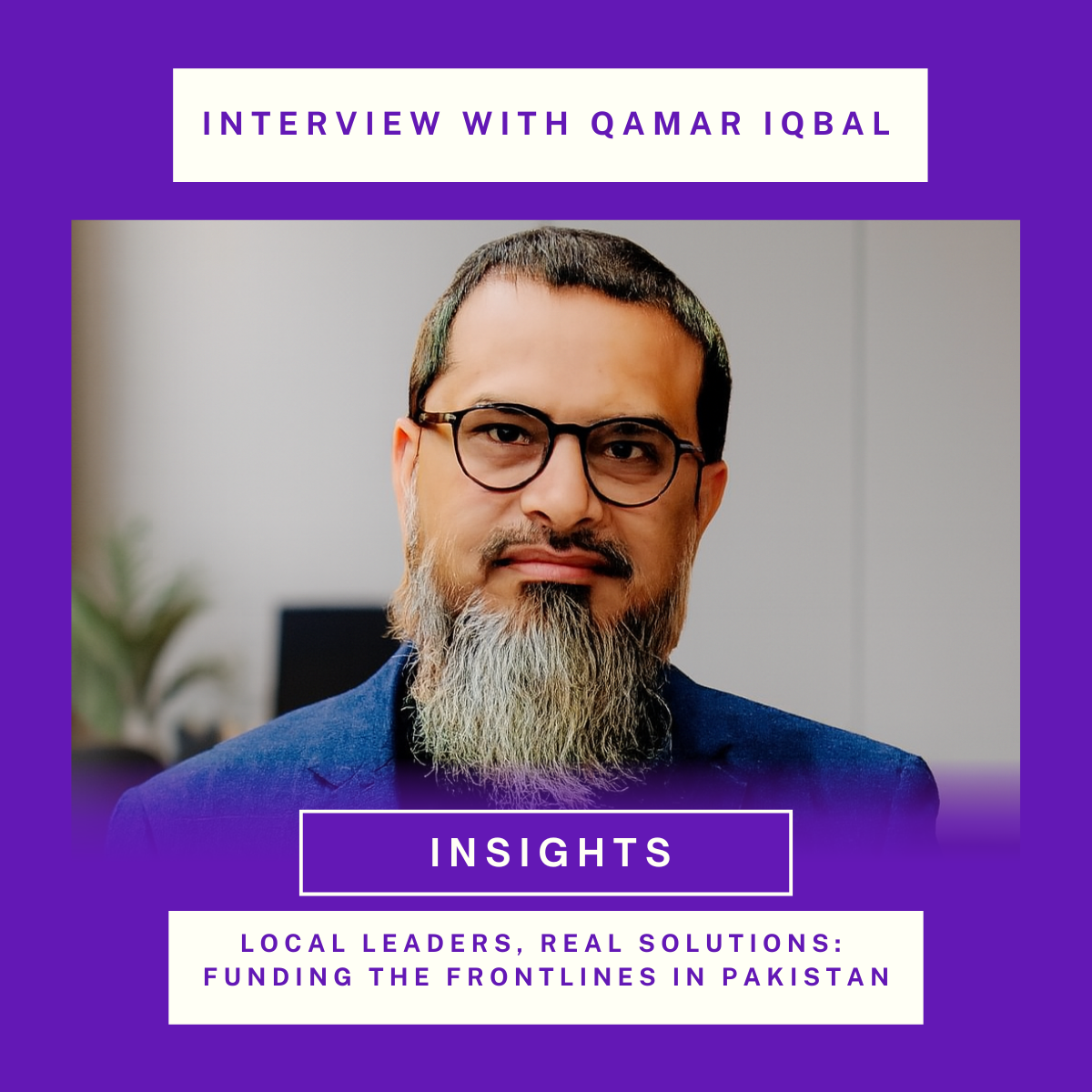
In this interview with Tamanna, Qamar Iqbal provides nuanced, experience, and expertise-driven insight into the philanthropic landscape of Pakistan. Questions of community leadership, local change-making, and the importance of shifting power toward grassroots organisations are explored. Qamar sheds light on the systems that shape philanthropy in Pakistan, the structural power imbalances that continue to prevail, as well as the rays of hope and transition that are emerging. Through his responses substantiated with powerful examples, Qamar makes a strong case for system change in favour of empowering local leaders and grassroots organisations with the resources and opportunities they need to make impactful change in their communities.
Qamar leaves us with a powerful personal reflection:
“If I reflect on this journey, one thing stands out clearly: the solutions we are looking for are already present within communities. I have seen local groups respond to crises faster than any formal system, young leaders drive change with minimal resources, and communities come together to support each other in ways that no external program could replicate. The challenge is not a lack of solutions—it is a lack of trust and investment in those solutions. For me, this work is ultimately about shifting that mindset. Moving from a system that controls and filters to one that listens and supports. Because when we truly invest in community leadership, we are not just improving funding systems—we are strengthening the foundation of sustainable change.”
Q1: You are the Co-Founder of Local Alliance Pakistan, Convener of CLWG Charter4Change Pakistan, Co-Chair of Advocacy WG of Charter4Change, and Co-Chair of EPWG Pledge for Change. What interventions and impacts are these initiatives making in the funding and community leadership landscape of Pakistan?
Across my different roles, the core focus has been about shifting the power, both in terms of funding and decision-making, closer to local and community-led organizations. This is not just a policy conversation for me; it comes from what I have witnessed repeatedly on the ground.
During the 2025 floods in Pakistan, I visited a rural community in southern Punjab where a small, informal group of young volunteers had already organized relief activities for the flood-affected population. They had mapped vulnerable households, prioritized elderly and women-headed families, and created a distribution system of emergency relief items—all without any external funding.
When international assistance eventually reached the area, larger organizations were funded to implement programs. The local group of young volunteers, despite doing the groundwork, was not engaged by those organizations.
That moment captured the core issue: communities are ready, capable, and leading—but the system is not designed to recognize or resource them.
Through platforms like Local Alliance Pakistan, Charter4Change, and Pledge for Change, we have been constantly trying to address exactly this gap. In Pakistan, that has meant advocating for localization, amplifying grassroots voices, and opening up spaces where local actors, especially youth and women, can influence decisions.
“We are seeing small shifts—more openness to direct partnerships and local leadership, but the deeper transformation is still ahead. For me, it’s about ensuring that communities are not just implementers, but decision-makers.”
Q2: Do you observe a general trend where bigger organisations access the majority of funding, leaving smaller, grassroots organisations under-resourced in Pakistan? If so, why do you think this is the case?
The concentration of funding among larger organizations is a pattern we see consistently.
I have worked with grassroots groups that run entire programs with minimal resources—often relying on volunteers, local fundraising, and community in-kind contributions. Yet when funding opportunities arise, they are expected to demonstrate the same systems and compliance structures as large, established organizations.
This creates a paradox. The very organizations that need investment to grow are excluded because they have not yet had that type of investment or resources, including human, technical, and institutional.
“At its core, this is about how we define risk. Right now, the system tends to reward what is already established, rather than what is locally effective. Until that changes, grassroots organizations will remain on the margins of funding flows.”
Q3: What is the role of compliance and regulations in raising and accessing funds for grassroots organisations in Pakistan? How does that impact the fundraising possibilities and financial stability of organisations?
Compliance is essential—we all recognize the need for transparency and accountability. But the way it plays out in practice can be challenging for smaller grassroots organizations.
Another challenge is the multi-layered and complex regulatory compliance requirements for the non-profit organizations working in Pakistan. I mean an organization that is registered under any law in Pakistan is not only complying with the regulator, but they also need to get the clearance/ NOC from federal, provincial, and district authorities before implementation of the project(s) in the target geographical area.
I recall working with a local organization focused on women’s economic empowerment. They had strong community trust and clear results, but navigating registration and reporting requirements took months. By the time they were ready, the funding window had closed.
What stood out was not a lack of capability—but a lack of access to systems and support. Their work continued, but without the scale it could have achieved with timely funding.
“This is a common experience. Compliance often becomes a barrier rather than an enabler. If we can move toward more proportionate and context-sensitive approaches, we can unlock the potential of many such community-based organizations.”
Q4: What is the picture of local, domestic philanthropy and fundraising like in Pakistan? Is there scope for organisations to mobilise models of crowdfunding, events/ campaign-based, and retail fundraising?
Pakistan has a strong culture of giving. You see it during Ramadan, in times of crisis, and in everyday acts of solidarity within communities.
But much of this giving is informal and focused on the immediate needs of the people. It does not always connect with organizations working on long-term and sustainable change models.
At the same time, I have observed encouraging shifts. Young people, in particular, are experimenting with digital fundraising—running small campaigns on social media (Facebook, Instagram, WhatsApp, etc.), mobilizing their networks, the diaspora community, and supporting local causes.
These efforts may seem small, but they represent a shift in mindset. With the right support, especially in storytelling and transparency, these models could grow into sustainable funding streams for grassroots organizations.
Q5: Are there any particular regions in Pakistan that receive less philanthropy than others? If so, why is that the case?
Funding in Pakistan is uneven, both geographically and socially.
I remember a conversation with a local activist from Balochistan who said, “We don’t lack solutions—we lack visibility.” That insight has stayed with me.
Many organizations in remote or marginalized areas are doing critical work, often under challenging conditions. But because they are not visible in national or international spaces, they are overlooked.
The other challenge is the security concerns of working in high-fragile contexts, especially in provincial bordering districts and high security zone districts due to international borders. Instability and security clearance for those vulnerable geographic regions restrict the funding flow to the civil society organizations.
“This is not just a funding issue—it’s a narrative issue. Whose stories are being told? Whose realities are being seen? Addressing these disparities requires us to amplify voices from underrepresented regions actively.”
Q6: Are there certain sectors or issues (for example: education or health) in Pakistan that receive more philanthropy, while other issues receive relatively less? If so, why is that the case?
Funding tends to concentrate in sectors like education, health, and humanitarian response. These are important, and their impact is often immediate and visible. Another factor of the charity-based funding model prioritizes orphans’ support and provision of drinking water due to the religious obligations and mindset of the international charities operating in Pakistan.
But I have seen organizations working on climate resilience or governance struggle to secure support.
One small women-led organization I engaged with was helping farmers adapt to changing weather and rainfall patterns—introducing climate-smart agricultural practices that were already showing results. Yet they struggled to attract funding because their work was seen as long-term and less tangible.
This raises an important question: are we funding what is most visible, or what is most needed?
If we want to build resilience, we need to invest in these less visible but deeply critical areas.
Q7: You previously mentioned that women-led and youth-led organisations are in a more disadvantaged, marginalised, and vulnerable position when it comes to fundraising and receiving philanthropy in Pakistan. Why do you feel that is the case?
Women-led and youth-led organizations face additional barriers that go beyond funding.
I have met young leaders with strong ideas and deep commitment, but limited access to networks where decisions are made. Similarly, women-led organizations often have to navigate biases that affect their credibility and visibility.
One example that stands out is a young woman leading a climate education initiative. Her work was impactful at the community level, but she struggled to access funding because she didn’t have institutional backing or the “right” connections.
The humanitarian and development ecosystem does not have a fair representation of women-led and youth-led organizations in the decision-making corridors. If they have the representation it is just tokenism, and their voices are not properly heard and considered while making the decisions, especially related to the funding or strategic decisions.
“These are not isolated cases. If we are serious about inclusion, we need to create intentional pathways—through funding, mentorship, and visibility—for these local leaders to thrive.”
Q8: What solutions and strategies would you recommend to enhance and advance fundraising and financial stability for grassroots organisations in Pakistan? These could relate to policy and regulatory systems, fundraising models, philanthropy approaches, or any other perspective.
From my experience, the solutions need to be both practical and systemic.
Simplifying regulatory processes and ensuring enabling policies would immediately open doors for many grassroots organizations. At the same time, we need to move toward trust-based funding—longer-term, flexible support that allows organizations to grow institutionally.
Investing in organizational capacity is also critical. Even small investments can make a big difference—whether it’s improving financial systems, communication strategies, or governance structures.
There is also a strong role for local intermediaries who understand the context and can support grassroots actors more effectively following the localization agenda.
And importantly, we should invest in digital tools and domestic fundraising. These are not just technical solutions—they are pathways to greater independence and sustainability.
Q9: What are some of the philanthropy and fundraising models, approaches, and practices that you have been part of, seen, or witnessed in Pakistan that have felt meaningful, impactful, and positive? Is it possible to replicate and multiply them across Pakistan and globally, and how?
There are already promising examples in Pakistan.
Pooled funding mechanisms have helped smaller organizations access resources more equitably. Community-led grantmaking has ensured that funding decisions are more relevant and context-driven.
Digital crowdfunding is also opening new possibilities. During recent humanitarian situations, I have observed small organizations mobilize support directly from communities and diaspora networks. Organizations have also accessed funding from renowned global crowdfunding platforms, subject to the NOC from the relevant authorities.
Distribution of zakat in Ramadhan and corporate social responsibility funds by the private sector is also an emerging trend that has been seen during the recent flood responses in Pakistan.
Some startups for local fundraising models based on the global best practices are attracting individual and corporate funders, but the acceleration of these startups would require consistency, time, and resources.
“These models work because they are built on trust and local knowledge. The challenge now is to scale them without losing these core principles.”
Q10: Are there any other trends, practices, challenges, and rays of hope in the philanthropy and fundraising landscape of Pakistan, particularly for grassroots organisations, that you would like to share?
We are at a moment of transition. The challenges—power imbalances, regulatory constraints, and unequal access—are still very present.
But there is also a shift happening. Conversations around localization, complementarity, and trust-based funding are gaining traction globally and locally.
What gives me the most hope is the resilience of grassroots organizations. Despite limited resources, they continue to lead change in their communities.
A visionary programme management leader with 25 years of experience advancing development and humanitarian action in Pakistan, representing Local Alliance Pakistan. A strategic thinker and partnership builder, he has driven policy influence, emergency response, and localisation—impacting millions. His work mobilizes funding, empowers grassroots leadership, and champions sustainable, community-led solutions across Climate Change, WASH, Food Security & Livelihoods, Health & Nutrition, and Governance.