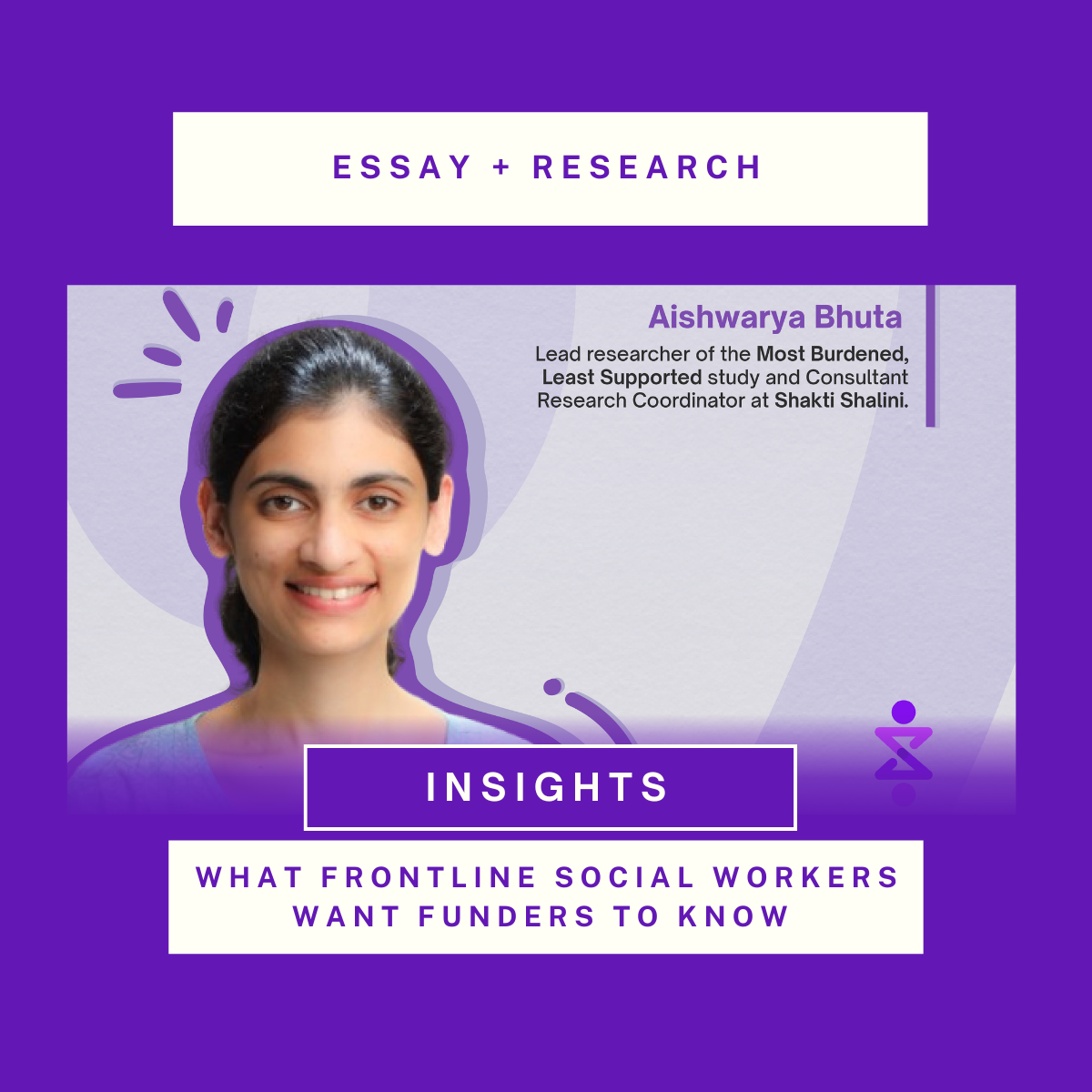
This Insight draws on research conducted by The Solidarity Network in India, exploring the safety, security, and wellbeing of frontline social workers. While the findings are grounded in one context, they raise important questions for funders everywhere about whose voices shape funding practices.
What makes this Insight particularly important is that it brings the voices of frontline social workers (and not the management of organisations) to the funding community. Within the philanthropic landscape, there is growing conversation on the importance of incorporating the experiences and feedback of grantee partners into grant-making systems and processes. While this is a welcome emergence, we need to acknowledge that, by and large, funders are predominantly hearing the voices of the management and leaders of organisations who already have various platforms and who, within their own spaces, hold positions of power.
This article, and the research study it draws from, is a small window through which funders directly hear from frontline social workers, a group otherwise one step removed from funders. This is very valuable since it is these frontline social workers that form the heart of the movements that funders aim to support:
The Solidarity Network was established by Shakti Shalini, an organisation based in India working for gender equality since 1987, after one of its counsellors was violently attacked while protecting the rights and safety of a survivor of gender-based violence. The incident exposed the risks faced by frontline social workers and led to the creation of a national network where frontline practitioners and human rights defenders could connect, learn from one another, and strengthen their collective safety, security, and wellbeing.
In 2026, the Network conducted one of the first studies to examine the physical, psycho-emotional, and financial security and wellbeing of frontline social workers in India. Drawing directly on their experiences, the study identifies three key ways funders can help strengthen the conditions that enable frontline workers to continue leading social change.
The recommendations for funders are summarised in the following three broad categories:
1. Earmark dedicated funds within every project or grant to support the physical safety and mental health needs of frontline social workers
Physical security entails safeguarding frontline social workers from physical harm, including violence. It also means ensuring they have the resources, equipment, and working conditions needed to carry out their roles safely and effectively.
Funders can support this by earmarking dedicated resources within every grant for the physical safety and mental health of frontline social workers. They can also encourage grantee organisations to prioritise these issues by incorporating explicit measures on staff safety and wellbeing into reporting and compliance requirements. This can help strengthen downward accountability by encouraging organisational leadership to demonstrate ethical employment practices and a commitment to the wellbeing of frontline staff.
2. Invest in self-care and collective care models for frontline social workers
Psycho-emotional security means ensuring that frontline social workers feel emotionally and psychologically safe and supported. This requires adequate resources to promote and institutionalise self-care and collective care practices across organisations.
Funders can encourage this by supporting regular training on stress management, boundary-setting, emotional regulation, grounding techniques, and other wellbeing practices for frontline teams. They can also invest in organisational and worker-led collective care initiatives, as well as peer networks that provide emergency support, information-sharing, legal aid referrals, and opportunities to exchange practices on self-care, collective care, and risk mitigation.
3. Provide flexible funding that enables organisations to prioritise the security of frontline staff
Financial security means ensuring that frontline social workers have access to decent work, fair remuneration, and the stability needed to meet their needs today while building security for the future.
Funders can support this by providing flexible, multi-year funding instead of short-term, output-driven grants that exacerbate employment precarity. Where funding must come to an end, providing organisations with a minimum notice period of three months can help reduce uncertainty and support a more responsible transition.
The recommendations emerging from this study are few in number, but they have the potential to create far-reaching change. As the research argues, meaningful progress will require action not only from grassroots organisations, but also from funders. Unless the safety, security, and wellbeing of frontline social workers become part of what funders prioritise through their grant-making practices, they are unlikely to become a consistent priority across the sector.
There is, however, a middle ground between respecting the autonomy of grassroots organisations and encouraging practices that strengthen the wellbeing and security of frontline staff. Funders already influence organisational priorities through what they ask about in proposals, what they require in reporting, and what they choose to resource. Organisations, in turn, adapt to these incentives.
If funders can influence practices such as impact measurement, reporting, and organisational systems, why not also encourage organisations to invest in the wellbeing and security of the people at the heart of social change? This can be done in many ways: by including questions about staff wellbeing in proposals and reporting, creating opportunities for peer learning, supporting conversations on the topic, or earmarking small grants to strengthen organisational wellbeing.
Perhaps the most important message this research offers is that this call for change has emerged from the grassroots themselves. It reflects the voices and experiences of frontline social workers – the people who sustain the movements that philanthropy ultimately seeks to support.
Read the full article, including the research methodology, findings, and recommendations:
About the Author:
Aishwarya Bhuta (she/her) is a PhD candidate at the University of Sheffield, United Kingdom. Her PhD is supported by an Economic and Social Research Council White Rose Doctoral Training Partnership scholarship. As a Consultant Research Coordinator at Shakti Shalini, she was the lead researcher of this study on the securities of frontline social workers. She has 5+ years of professional experience spanning academia, grassroots organisations, a think tank, and a consulting firm.
Previously, she was a Research Consultant at the Centre for Budget and Governance Accountability, India. She is keenly interested in Gender and Development research in India. A social scientist by training, Aishwarya holds an MA in Development and Labour Studies from Jawaharlal Nehru University, India, and an MA in Social Research from the University of Sheffield.