Beyond the Wave: Reimagining Philanthropy in an Age of Corruption
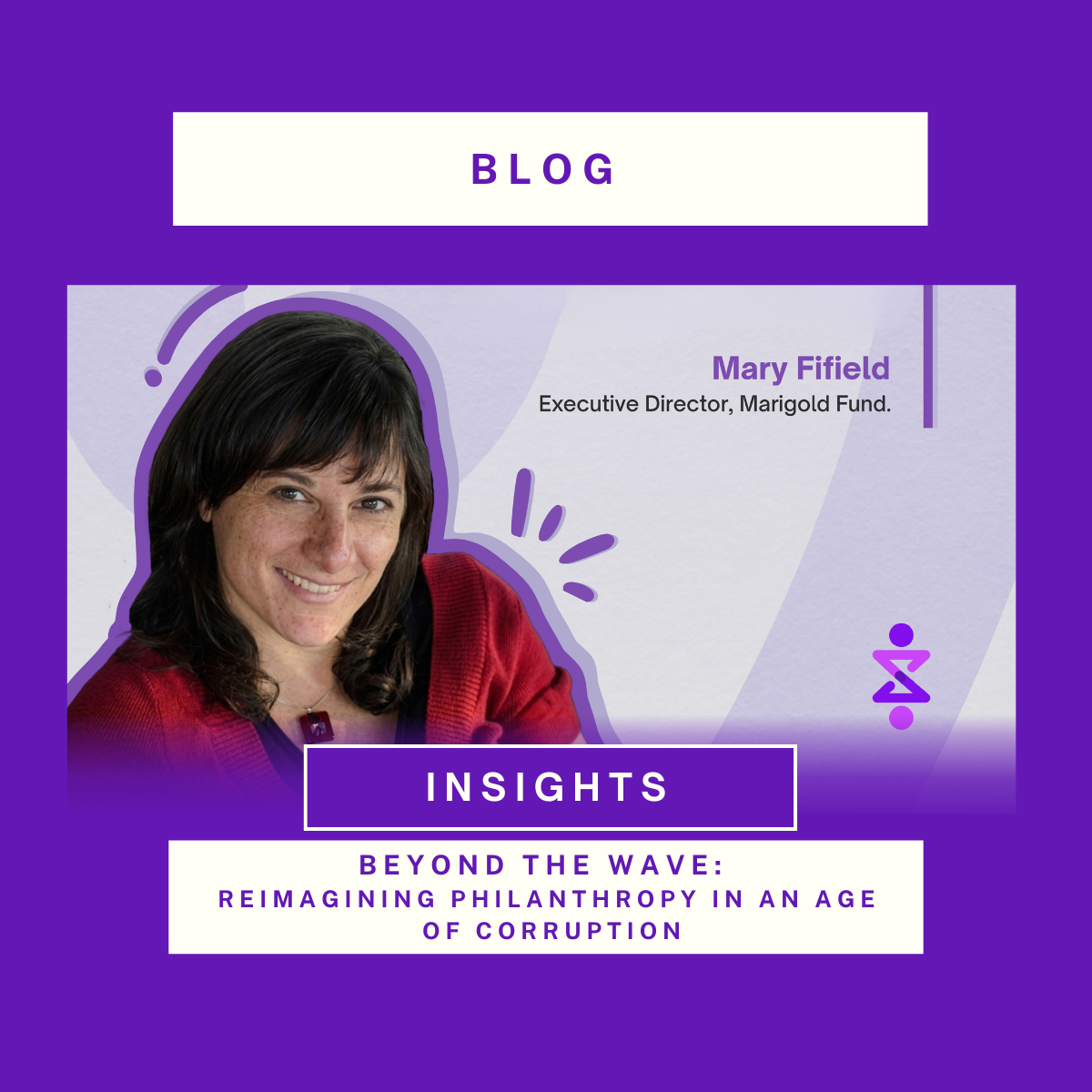
By Mary Fifield, Executive Director, Marigold Fund
In fall of 2024, as I sat in a circle with dozens of grassroots leaders who discussed the history of Mexico’s socio-environmental movement, the complexities and contradictions of the current leftist government’s positions, and what it meant for marginalized communities, I couldn’t shake an image: a swell rises in the middle of the ocean, gains mass and speed as it becomes an unstoppable wave heading to shore, and then crashes against a huge vertical cliff. The wave flattens and the sea foam slowly vanishes from the rock face, leaving a just damp shadow as evidence of the wave’s reach.
This metaphor haunted me for weeks afterwards. The wave was the many inspiring, powerful grassroots movements for buen vivir,[1] and the immovable cliff was global corruption embedded in various economic and political systems. Even worse was the sense of repetition, like an animated flip book that turns static images into a moving sequence that runs over and over again.
A couple months after that convening, Donald Trump was again elected president of the U.S., and corruption reached cartoonish proportions. Of course the struggle for democracy against grift has ebbed and flowed innumerable times in history, but the stakes keep getting higher. At Marigold Fund we concluded that not only is systemic corruption the biggest obstacle to resolving the climate crisis, but as funders of community organizations fighting for the right to a livable planet, we have to take an explicit stand on it. Otherwise, we are undermining the very support we deliver to help our grantee partners make their necessary vision a reality.
__________
In late 2023 the board of Cotyledon Fund, where I served as Director of Programs, spun off a new entity, Marigold Fund, around the organizations in my portfolio. One of our first priorities was to articulate a strategy that arose from our work with existing grantee partners and the values we all share, which drew us together in the first place.
Our team decided to analyze the fund’s potential from the perspective of the entire portfolio rather than the results of individual organizations in isolation. We wanted to understand the collective impact of the group, the challenges organizations had in common despite different geographies and populations, and the relationship between the values of the cohort and the needs appearing on the horizon that we might be able to identify by taking a portfolio view.
This two-year effort entailed many conversations with grantee partners, other grassroots leaders working on systems change initiatives, funders, and colleagues outside of philanthropy. We cast a wide net in our research, gleaning insights from writers, artists, and thinkers as diverse as Naomi Klein, Carlos Labbé, Ian McGilchrist, Faiz Shakir, Joanna Macy, Gab Mejia, Abigail Disney, Sammy Roth, and Teresa Rodríguez de La Vega, among others. The events and chaos of the last couple of years made it clear that communities would keep organizing for socio-environmental well-being despite the forces arrayed against them. They continued to be part of the wave, and we would continue to support them. But as rapidly concentrating wealth and power converged into widespread, grotesque, and blatant global oligarchy, the cliff of corruption loomed even larger and more impenetrable. Something needed to begin eroding that cliff if the full power of the wave was to be harnessed.
This was a daunting realization that could easily lead to delusional hubris or fearful paralysis. We didn’t want to fall into either trap. With finite financial and people resources, what could we realistically do?
First, we decided not to buy into the false all-or-nothing binary.
We recognize that intention is as important as outcome in this effort, and that means engaging with the uncertainty of an unfolding process. We will do our best, accept our limitations, but continue listening, learning, and looking for opportunities to erode the cliff. We will push ourselves to be creative and bold, always in collaboration with others working toward a more fair, compassionate, and healthy society for all beings.
We named corruption as a threat and antidotes to corruption as an organizing principle for our strategy.
With input from our grantee partners, we drafted new funding guidelines, refined our focus areas, and brainstormed ways to test our theory of change. Through this iterative process, we are developing a road map with simple indicators to help us stay on course for the next several years.
We are applying specific grantmaking practices to specific components of our strategy for greater agility and impact.
We are co-designing programs with some of our grantees, experimenting with open calls and participatory grantmaking, and considering the degree to which we may be able to streamline our “beyond-the-check” support. This is a work-in-progress. We are not adopting any one practice wholesale; rather, our goal is to be selective and thoughtful in finding the right tools for the right situation.
We will engage other funders in the topic of corruption.
It’s no secret that philanthropy has a unique and complex relationship to concentrated wealth and power, and many serious efforts are underway to shift the power in philanthropy and flow more financial resources to communities. But conversations about how this money and power accumulate in the first place, and the structures that perpetuate this wealth concentration before it even ends up in a foundation’s corpus, are less common and in our view urgently necessary. By no means do we have all of the answers, but we do believe it’s time for a more rigorous discussion on the topic.
__________
So many touchstones–from institutions to assumptions–have been cast aside, weakened, or demolished, with both positive and negative consequences. We don’t know what the future will hold, and we are not wedded to a preconceived notion of “success” or “effectiveness.” We do know that the tentativeness that may have been justified in previous eras can become a dangerous crutch now, just as fear and reactivity can blind us to better paths. We believe this moment calls for clarity, a willingness to take risks, communication, and self-awareness. Summoning as much compassion as possible for others and ourselves, we are doing what we can to answer this call.
[1] The Indigenous world view “buen vivir” (“good life” in Spanish) or “sumak kawsay” in Kichwa expresses a recognition of the “fullness of life, rooted in community, and in harmony with other people and nature.” The terms arise from Andean Indigenous communities (and are enshrined in the Ecuadorian and Bolivian constitutions), but the perspectives and values are shared among many other peoples around the world.
About the Author
Mary Fifield is a writer and community development practitioner who has lived and worked in Latin America. She is executive director of Marigold Fund and based in San Diego, CA, USA.
More from this author: https://thebreakingopen.substack.com/