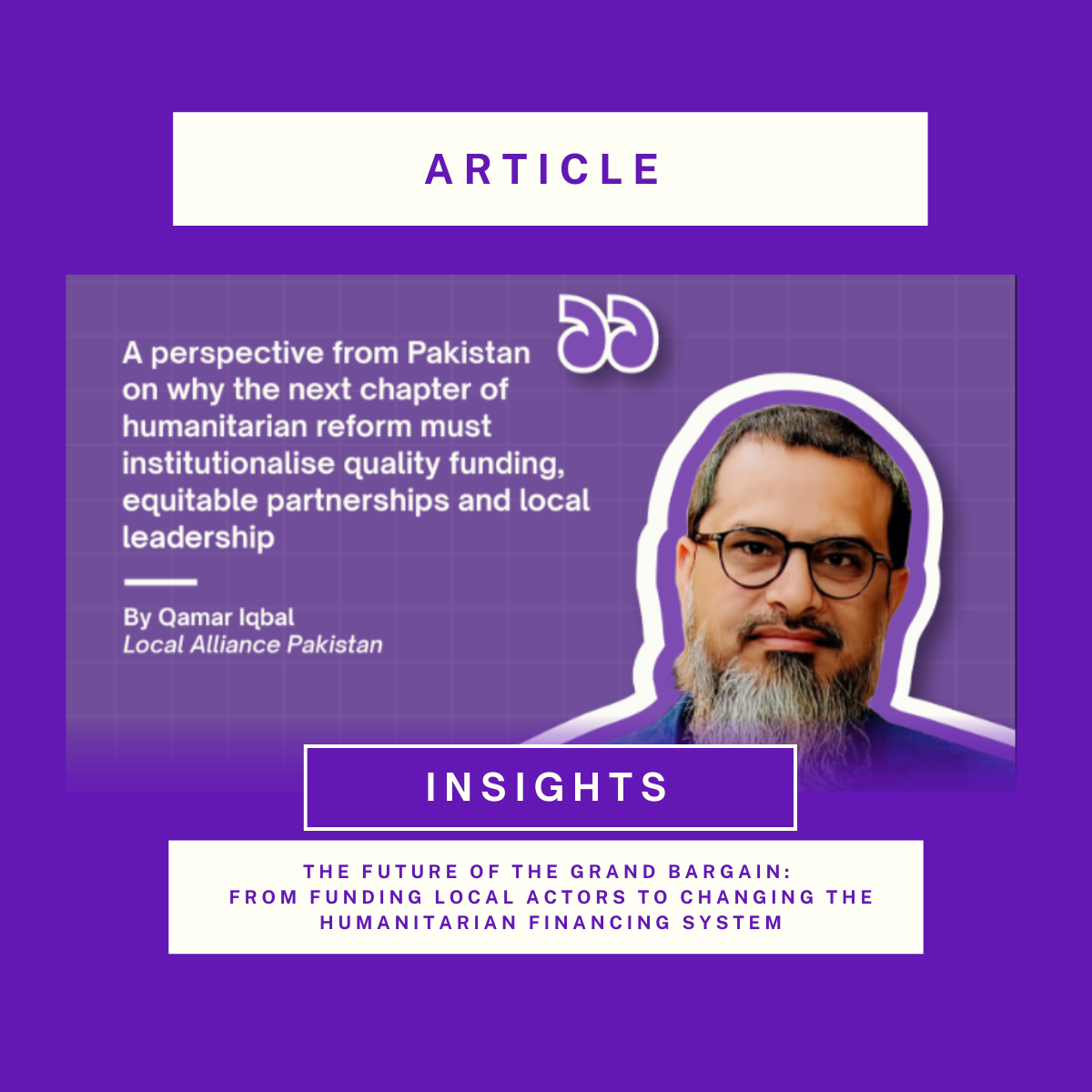
By Qamar Iqbal | Local Alliance Pakistan
Ten years after the launch of the Grand Bargain, an international agreement established in 2016 to improve the effectiveness and efficiency of humanitarian assistance, questions remain about how much has changed for local and national organisations.
While the Grand Bargain has helped bring localisation, quality funding and equitable partnerships into humanitarian reform discussions, significant inequalities persist in how resources, risks and decision-making power are distributed.
In this Insight, our collaborator, Qamar Iqbal of Local Alliance Pakistan examines these challenges from the perspective of local humanitarian actors in Pakistan. Building on his earlier reflections for Better Funding, he argues that increasing funding to local organisations is not enough if the structures governing those resources remain unchanged.
As he puts it:
“We have increasingly localised implementation without sufficiently localising financial power.”
From commitments to systemic change
Qamar’s contribution moves beyond identifying the limitations of current humanitarian financing arrangements to explore what meaningful reform could look like.
He makes the case for institutionalising quality funding and equitable partnerships, rather than leaving better funding practices dependent on the decisions of individual donors and organisations.
The article explores three interconnected questions:
- How should we measure progress? Moving beyond the volume of funding reaching local actors to consider its quality and the power associated with it.
- What needs to change in funding relationships? Examining the role of intermediaries, institutional investment, risk sharing and local decision-making.
- How can principles translate into practice? Exploring concrete proposals for reform, including a potential country-level approach in Pakistan.
At its heart, Qamar’s argument invites the humanitarian sector to reconsider what successful localisation should look like – not simply in terms of who receives funding, but who has the power to shape how it is used.
Read the full Insight to explore Qamar’s analysis and proposals for the future of humanitarian financing:
About the Author:
A visionary programme management leader with 25 years of experience advancing development and humanitarian action in Pakistan, representing Local Alliance Pakistan. A strategic thinker and partnership builder, he has driven policy influence, emergency response, and localisation—impacting millions. His work mobilizes funding, empowers grassroots leadership, and champions sustainable, community-led solutions across Climate Change, WASH, Food Security & Livelihoods, Health & Nutrition, and Governance.