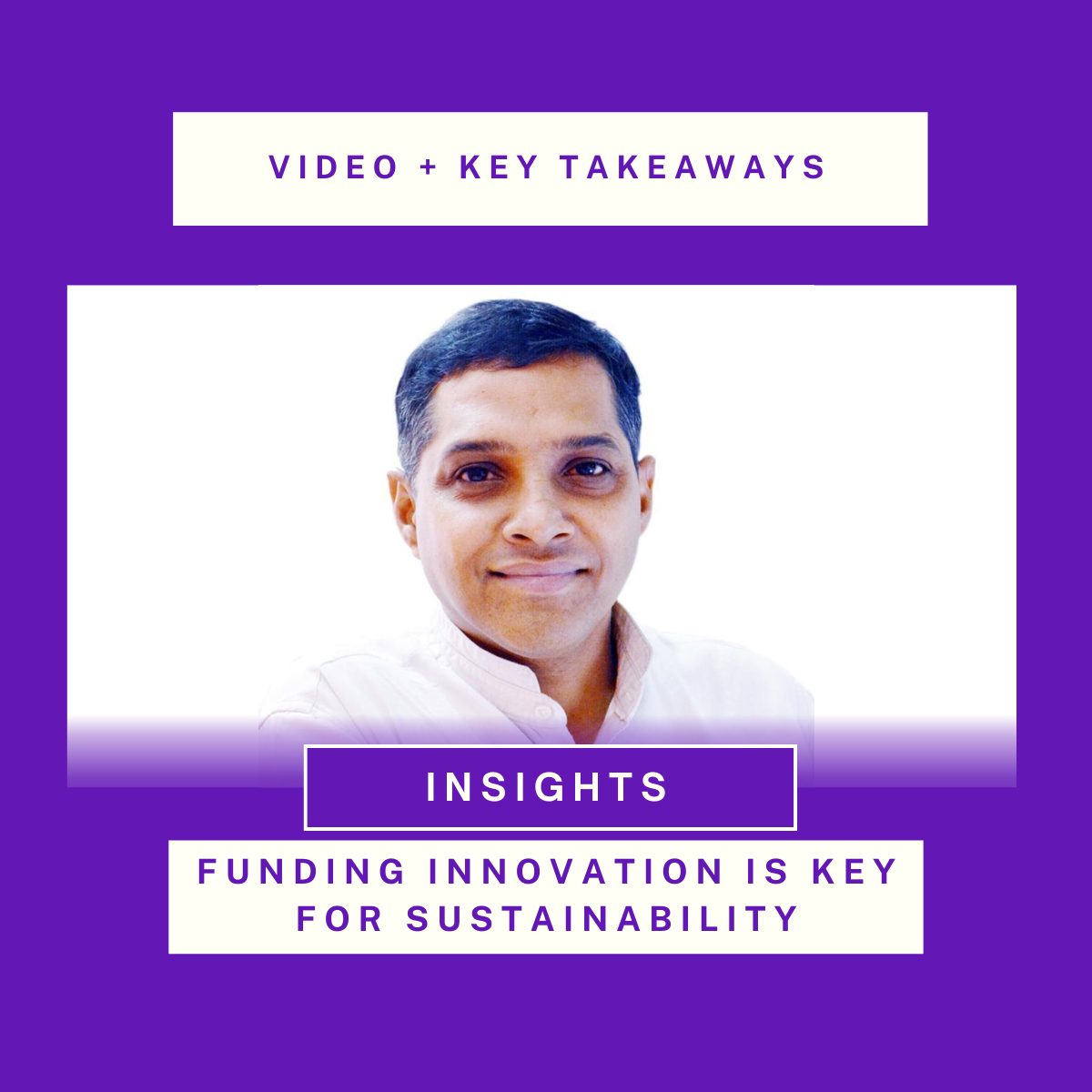
In this insight, Emily interviews Arup Ghosh, Co-Founder of Tomorrow’s Foundation, an NGO working across India on education, skills and livelihoods and climate adaptation and mitigation.
Founded 34 years ago, Tomorrow’s Foundation has grown enormously and expanded its innovative programmes across many marginalised regions of the country. Crucially, the government has now adopted many of their interventions.
Arup reflects on the role that funding – and funders – have played in the organisation’s growth and sustainability.
Some key highlights from Arup’s reflections:
- Arup and his twin brother Swarup co-founded the organisation at only 19 years’ of age, following a meeting with Mother Theresa in their home city of Kolkata.
- At the beginning, Tomorrow’s Foundation was mostly funded by donations from family and friends, but their funding profile has evolved over the years as they have grown.
- Their ‘funding pie’ now consists of corporate social responsibility (CSR) funders, philanthropic foundations and the government.
- As a social entrepreneur, innovation has been very important to Arup – they are constantly working with the communities to identify new needs and new solutions. That innovation has to come from the communities.
- Trust-based funding has been essential to support these new innovations – funders who know and trust them, and with whom they have a good relationship, are generally the ones who have stepped up to fund new projects and ideas and have provided unrestricted funding.
- This unrestricted funding is critical for innovation. NGOs need to be able to try and test and challenge in the same way commercial startups do – they need to be able to experiment to see what might work.
- CSR funding tends to come in once they have an established model that’s working – when they can prove success.
- When this model is more advanced, they can then take it to the government to scale the work. Ultimately, their goal is to have the government take over funding initiatives because that’s necessary both in terms of scale and sustainability.
- They have found that different funding works at different stages of a project. Once you have a more proven model and can demonstrate results, it’s easier to attract other kinds of funding.
- Having different funders (family foundations, CSR and government) means that risks are being hedged – and this is important for sustainability.
- Transparency, openness and being able to share bold new ideas – these are qualities Arup values in a relationship with a funder.
- It’s critical to always focus on the communities’ needs and not the organisation or funder’s needs. Organisations have a role to play in facilitating those conversations so that funders can understand the needs of communities.
- One of the biggest challenges that the organisation has faced is that they need talent to grow the organisation – but to attract and retain good talent, you need to provide the right compensation package.
- Funds are generally only given for implementation and not for capacity building or for research – and to try new approaches and innovate, they need funds for research.
- Funders in the social sector tend to be more risk adverse than in the private sector. Funders need to accept that a new idea or project might fail, but that will bring new wisdom or a new way of looking at things. There needs to be a mindset shift.
- Accountability has to be at all levels – to the community first because they are the participants, and also to the funder.
- CSR is gaining a lot of momentum in India, but it is centred in certain areas, mostly in the Western and Northern parts of the country, and less in the East and Northeast where there are fewer industries. Companies tend to want to see money go into their surrounding neighbourhoods. Arup would love to see them branch out into the most under-served areas, where Tomorrow’s Foundation strives to work.
- Funding timespan is a challenge, as CSR funding is often for one year, sometimes two or three years, but this is not long enough to show impact for an education project or a livelihood project. It takes a minimum of five years to create a model and begin to scale it up.
- Work has to be collaborative – a partnership between the community, the project developer and the funder. Funders should be asking: how can we capacitate this? And bring in other co-funders to support work.
- More trust-based funders and funders with a higher appetite for risk are needed to support innovation and new approaches to the challenges we’re trying to solve.
About the speaker:
Arup Ghosh is a social entrepreneur and the Co-Founder of Tomorrow’s Foundation.
For more information on Tomorrow’s Foundation’s inspirational work with communities in India, visit: https://tomorrowsfoundation.org.in/