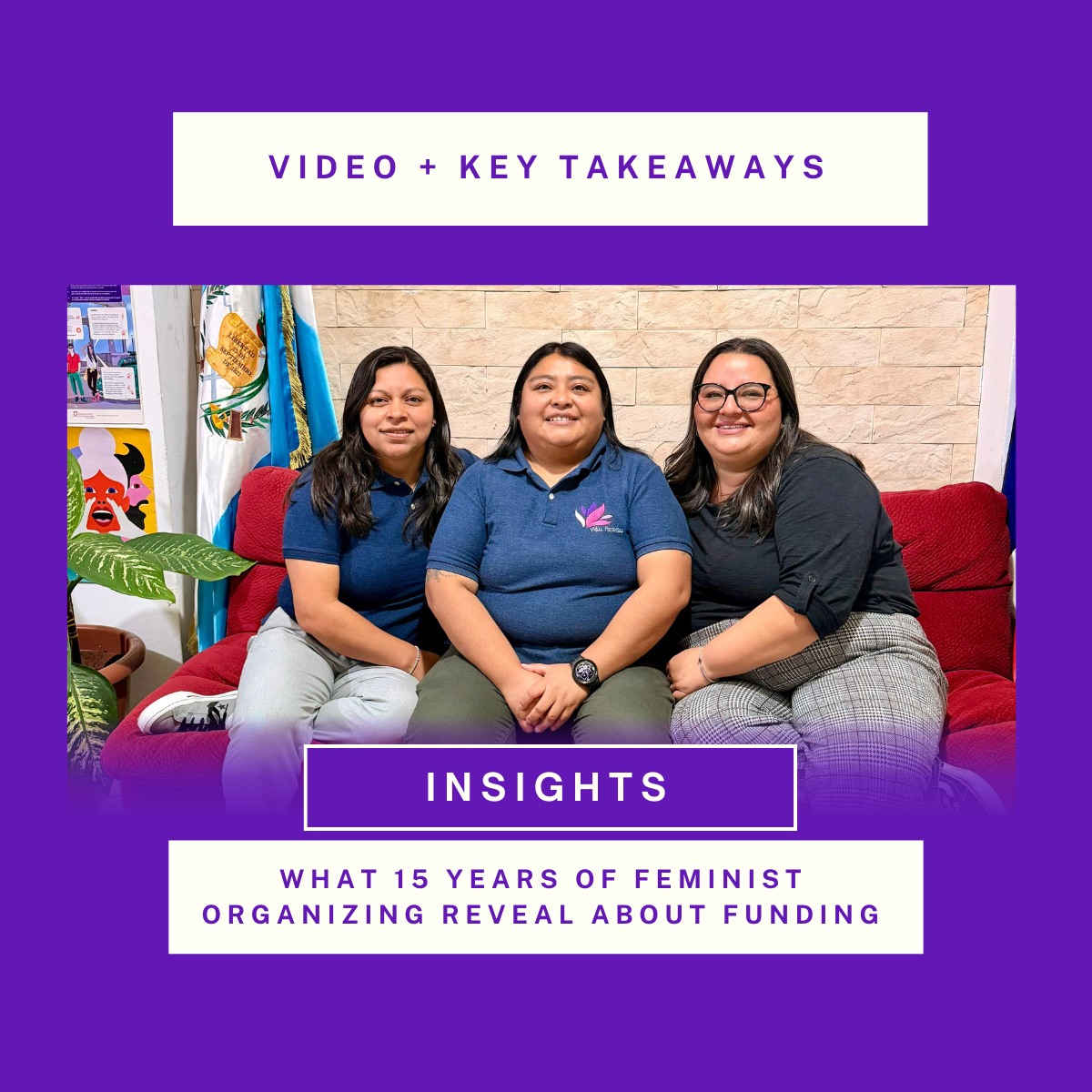
In this Better Funding Insight, Andrea Díaz, Erika Hernández, and Anelisse Amaya from Vidas Paralelas — a feminist organization of lesbian and bisexual women based in Quetzaltenango, Guatemala — reflect on nearly 15 years of organizing and the role funding has played in their journey. From their early days as a collective to becoming an established organization, they share concrete experiences of what has strengthened their work, what has limited it, and what kind of funding is needed moving forward to truly support feminist movements.
This are the key takeaways:
1. Funding must respond to movements, not the other way around
After nearly 15 years of organizing, Vidas Paralelas is clear: funding is most effective when it adapts to the realities of feminist movements, rather than requiring organizations to reshape their work to fit rigid frameworks.
This means recognizing that:
- Movements operate in complex, evolving contexts.
- Needs cannot always be predicted or predefined.
- Organizations require the ability to respond in real time to the communities they serve.
At its core, this is a shift from compliance-driven funding to context-responsive support.
2. Flexibility is not a “nice to have”, it is essential infrastructure
Flexible funding has been one of the most impactful forms of support Vidas Paralelas has experienced.
In practice, flexibility includes:
- The ability to reallocate funds based on emerging needs.
- Adaptable administrative processes that reduce unnecessary paperwork.
- Freedom to design and implement activities informed by lived realities.
This flexibility allowed them to act on urgent needs, from covering transportation to providing shelter and food, without being constrained by rigid budget lines or approval processes.
3. Trust allows organizations to lead with their expertise
The most impactful funding relationships were trust-based.
Early support from the Central American Women’s Fund (FCAM) is a defining example:
- They funded the organization before it was formally registered.
- They accepted context-appropriate financial practices (e.g. simple receipts).
- They created space for learning by doing, rather than requiring perfection from the outset.
This trust translated into autonomy. As they describe it:
Being able to say “this is the situation, this is what we need” and be trusted to act accordingly.
4. Multi-year funding is critical for meaningful impact
Short-term funding cycles (6–12 months) are fundamentally misaligned with the realities of social change.
Vidas Paralelas highlights that:
- Personal, social, and legal processes cannot be resolved within a year.
- Short cycles often result in unfinished work and lost progress.
- Organizations are forced into constant fundraising, reducing focus on their core work.
By contrast, multi-year support enables continuity and depth. Their current experience with IM Swedish Development Partner is one example of how longer funding cycles allow processes to continue, deepen, and generate more meaningful outcomes over time.
Multi-year funding (3–5 years) allows organizations to:
- Build sustained relationships with participants.
- Accompany long-term processes of change.
- Plan strategically rather than reactively.
5. Core and operational costs are essential, not optional
Funding that excludes operational costs undermines organizational sustainability.
Key needs include:
- Rent and physical spaces (which often function as safe spaces for participants).
- Utilities (electricity, water, internet).
- Administrative and coordination capacity.
Without this support, organizations are forced to operate precariously, even when their programs are funded.
6. Restrictions on salaries can undermine dignity and effectiveness
Caps on salary allocations (e.g. 20–30%) fail to reflect the realities of movement work.
These limitations:
- Prevent organizations from offering fair compensation.
- Limit access to social protections (such as healthcare systems).
- Ignore the intensity and flexibility required in this work (often beyond standard working hours).
Sustainable funding must recognize that people are central to the work and must be supported accordingly.
7. “Invisible” movement-building work must be resourced
Some of the most critical aspects of organizing are often overlooked in funding structures, including:
- Collective spaces for reflection and decision-making.
- Community-building and convening.
- Self-care and collective care practices.
These are not peripheral, they are core to the strength and sustainability of movements.
8. Participatory and relational processes strengthen funding practice
Vidas Paralelas highlights the value of funding processes that:
- Create opportunities for collective decision-making among applicants.
- Foster relationships rather than transactions.
- Prioritize learning and exchange.
These approaches redistribute power and build stronger ecosystems.
9. Autonomy in defining impact matters
Organizations must be trusted to define how impact is measured in their context.
Rigid, externally imposed indicators often fail to capture:
- Emotional, social, and community-level change.
- Long-term processes of transformation.
- The realities of working with marginalized communities.
Respecting locally defined approaches to evaluation is a key component of equitable funding.
10. Stability enables deeper, more focused work
Without long-term, reliable funding, organizations operate in a constant state of uncertainty.
This creates:
- Fragmented attention (balancing program delivery with fundraising).
- Emotional and operational strain.
- Difficulty sustaining essential infrastructure.
By contrast, stable funding provides:
- Peace of mind
- Greater focus on impact
- Stronger organizational resilience
11. Trust-based funding is not a concept, it is a practice
For Vidas Paralelas, trust is not abstract. It is embedded in how funding works in practice:
- Covering essential costs.
- Allowing flexibility in use of funds.
- Reducing control and micromanagement.
- Respecting organizational judgment.
- Supporting long-term processes.
Trust is what enables all other elements to function.
12. A clear call forward
The conversation leads to a clear conclusion:
Feminist movements need funding that:
- Responds to their realities.
- Trusts their expertise.
- Supports their sustainability.
- And allows them to define their own paths.
Not the other way around.
Vidas Paralelas is a feminist organization of lesbian and bisexual women based in Quetzaltenango, Guatemala. For nearly 15 years, they have worked to advance the rights and wellbeing of diverse women through feminist organizing, sexual and reproductive rights advocacy, civic and political education, and work on migration and trafficking. Their approach also integrates artivism as a tool for expression, capacity-building, and community connection. Rooted in lived experience and collective care, Vidas Paralelas creates safe spaces and supports women navigating complex social, emotional, and legal realities in their communities.
🔗Learn more about Vidas Paralelas: https://vdsparalelas.org/